
Short answer
For an ordinary home 11 kW is almost always enough. That charges an average electric car from nearly empty to full in a single night. 22 kW is usually unnecessary: many cars cannot draw more than 11 kW at home.
More important than the power is the control: a charge point that watches your solar panels and the rest of your house charges more cheaply and does not trip your main fuse.
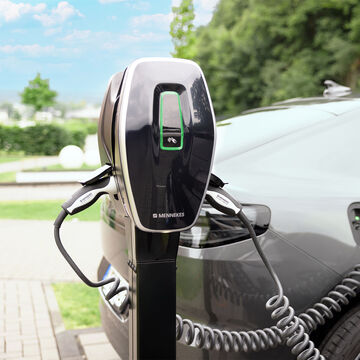

Our charge points come from MENNEKES. This is the German company that designed the type 2 plug which is the European standard today — literally the company behind the plug that fits your car. We fit their AMTRON® 4You range: produced entirely in Germany, built to be mounted outdoors, and designed to work together with solar panels rather than sitting alongside them.
Surplus charging uses the electricity your panels have spare. The charge point switches automatically between one and three phases, so it keeps charging even on a small surplus.
MENNEKES has been building industrial plugs since 1935. Every charge point is produced entirely in Germany — and that is also where you will still find a spare part in ten years.
Resistant to rain, dust and a firm knock. Just as at home on an outside wall as in the garage or carport.
A fixed type 2 cable of 7.5 metres that winds neatly around the unit, and the 4Drivers app to follow charging sessions and usage.
Charging an electric car from an ordinary socket takes more than a full day, and that socket was never designed to run at full load for hours on end. A fixed charge point exists not because it is faster, but because it is safe: its own circuit, its own protection, and a device that knows when to stop.
At 11 kW you add roughly 50 to 60 kilometres of range per hour. A 60 kWh battery goes from nearly empty to full in around six hours at that rate. Overnight you have eight to ten hours, not twenty minutes — so at home you simply do not need it faster.
On top of that, a great many electric cars will not draw more than 11 kW at home, however powerful your charge point is. Buy 22 kW and you are paying for power the car cannot use. That is why we always ask for the make and model of your car before we propose a rating.
| Your situation | What we recommend |
|---|---|
| Single-phase connection, ordinary journeys | 7.4 kW. Charges a full battery in about nine hours — comfortably within a night. |
| Three-phase connection | 11 kW. The usual rating for home, and the maximum most cars can take. |
| Solar panels on the roof | 11 kW with surplus charging and automatic phase switching, so you charge on what you generate yourself. |
| Two electric cars | Load management across both charge points, so together they stay within your connection. |
| Company car charged at home | A model with an MID-compliant meter, so your employer can reimburse the kWh correctly. |
Since the digital meter arrived, your meter no longer runs backwards. Electricity you generate during the day and do not use yourself is sold for a fraction of what you pay for it in the evening. Your car is the largest appliance in the house that you can shift to the sunny hours without losing any comfort — and therefore the quickest way to turn that difference in your favour.
That is why the AMTRON 4You charges on surplus: it takes only what your panels have spare at that moment. The weak spot in such an arrangement is usually the lower limit — on a cloudy afternoon there is too little surplus for three phases and an ordinary charge point drops out. This one switches back to a single phase automatically and carries on charging quietly. The energy management software also decides every quarter of an hour what takes priority: the battery, the hot water tank or the car.
Part of your bill depends on your highest quarter-hour peak: the quarter of an hour in which you used the most at once. Switch on a charge point while the heat pump is running, the oven is on and the dishwasher has just started, and you fix that peak for a whole year.
Dynamic load management prevents that. The charge point watches what the rest of the house is doing and backs off when things get busy. You notice nothing — your car is standing there all night anyway — but your bill does. More about that on the page about the capacity tariff.
A charge point is a change to your electrical installation. In Flanders it must be inspected by an approved inspection body before it goes into service. Allow roughly 125 to 250 euros, paid to the inspection body, not to us.
What usually makes an inspection fail is not the charge point itself but the paperwork: a missing single-line diagram or position diagram. We supply those drawings with the installation, together with the separate circuit and the correct residual-current protection the inspector will check.
Three things determine almost the whole quote, and you can usually look them up yourself: whether your connection is single-phase or three-phase (it is on your consumer unit or on your bill), how many metres there are between your consumer unit and where the car stands, and which car it is. With those three, we can be concrete on site straight away instead of estimating.
For an ordinary home 11 kW is almost always enough — good for roughly 50 to 60 kilometres of range per charging hour, so a full battery in one night.
22 kW is usually unnecessary: many cars cannot draw more than 11 kW at home, so you pay for power your car never uses.
For 11 kW, yes. If you have a classic single-phase connection you charge at up to roughly 7.4 kW — for most families still comfortably a full night.
We read your consumer unit during the site inspection and tell you honestly whether upgrading your connection is worth it or not.
Yes — that is called surplus charging. The charge point uses only the electricity your panels have spare at that moment, which you would otherwise export for a fraction of the price.
To do that the AMTRON 4You switches automatically between one and three phases, so it keeps charging on a cloudy afternoon instead of dropping out.
Yes. A charge point is a change to your installation and in Flanders it must be inspected by an approved inspection body before it goes into service. Allow roughly 125 to 250 euros, paid to the inspection body.
We supply the single-line diagram and the position diagram with it, because without those drawings the inspector cannot approve your installation.
The charge point watches what the rest of your house is using at that moment and adjusts its charging speed accordingly.
Without it, the car, heat pump, oven and dishwasher running together can trip your main fuse — and it pushes up your quarter-hour peak, which you then pay for through the capacity tariff for a whole year. We enable load management as standard.
Yes. The AMTRON 4You has protection rating IP54 and impact rating IK10: rain, dust and an unlucky knock do not harm it. It sits just as well on an outside wall as in a garage or carport.
Yes. The fixed charging cable is type 2, the European standard for alternating current, and that is fitted to virtually every electric or plug-in hybrid car sold in Europe.
A charge point is therefore not a choice that locks you to your current car.
There is a version with an MID-compliant meter built in, so the kWh charged can be officially recorded and reimbursed by your employer.
Which version we propose as standard for that: [TO BE CONFIRMED]
We work with the MENNEKES AMTRON® 4You range. The models differ mainly in access control (RFID key), metering and app functions; the 7.5 metre charging cable and the housing are the same.
Which model we propose as standard and the price range including installation: [TO BE CONFIRMED]
Alongside the MENNEKES factory warranty, ADW gives its own guarantee on the installation work.
Exact terms on your file: [TO BE CONFIRMED]
Tell us a little about your home and what you're after. We'll come out, take a look, and send a clear, no-pressure quote.
+32 495 30 38 99
koen.dewolf@alu-dewolf.be
Elzelestraat 138, 9600 Ronse
Keistraat 3, 9681 Maarkedal, Belgium
By appointment only